Showing posts with label mad science. Show all posts

28 April, 2010

How to Make Carbon Nanotubes

So I've been reading around, and I came across some methodology that suggested it is relatively straightforward to grow short carbon nanotubes. According to their recipe:

1) Construct vacuum chamber with heavy-duty anode and cathode within.

2) Bridge electrodes with carbon rod, evacuate atmosphere from chamber.

3) Arc 220V electricity through the carbon rod.

4) Carbon nanotubes will grow upon the anode.

5) Modulate chemical properties of carbon nanotubes by changing the atmosphere of the vacuum chamber. Apparently it's not so much important that there be no atmosphere as it is that there be no oxygen, which is fine by me as it is easier to build. Hydrogen makes sweeter nanotubes, while a nitrogen mix makes for more bitter ones.

It should probably be noted that I don't exactly yet know what it is I'm going to do with carbon nanotubes once I've grown them--in fact, that's an understatement, I have no clue--but that's not likely to stop me here. Now all I have to figure out is how to build a "vacuum" chamber. Maybe I can bribe a hacker with muffins to suck all the air out through a scuba mask regulator...

10 August, 2009

How to Explain the Senses?

Crowdsourcing: to open up the development process of any given project to the public in a meaningful way that allows the public to impact the course of that project's development.
Ann Arbor, Michigan is about to have a mini-Makers' Faire (as opposed to a Gigantic Makers' Faire). This entails a large gathering of creative people showing off the products of their creativity and ingenuity in a public forum. Typically there are demonstrations, learning, and sharing as most everything is open access. Basically, it is a gathering of nerds who like to make stuff teaching other nerds of similar aptitude, and the curious public, about the stuff they made. The purpose is to share, awe, inspire, educate, elucidate, demonstrate, and possibly also confuse.

I've gotten in on this, and a project is rapidly coalescing. In the Sensory Augmentation Devices booth, we're trying to demonstrate the electrical properties of nerves. However, to do this live and in real time, we must also tread carefully to avoid disgusting the public. Listed below are the ideas so far, and they are open to your comments and criticism.

1) Brain-ablated Xenopus (frog*) with thoracic cavity open connected to electrical leads at each limb in a physiological solution of potassium chloride. Each electrical lead will be run by a robotic sensor glove such that movement of the glove will induce neuromuscular contraction in the frog limbs. In effect, this is a frog puppet. We hope that the physiological potassion chloride solution will allow passive diffusion of ions back into nerve cells and allow for repeated contractions.

2) Similarly, brain-ablated Xenopus with thoracic cavity open and heart connected to an LED through a tranformer. The blinking LED will demonstrate to observers that the heart does indeed contract due to pulsed electrical impulses.

3) Petri dishes of rat or mouse neurons with silica implants connected to a computerized output to show random electrical activity of cultured neurons. We have a source of cultured neurons, but we still need a way to get a signal amplified out of them.

4) Brain model, either preserved real or plastic so that we can get the neuroscientists among us to explain the structural functionality of the brain and how it relates to neonatal development in humans, as well as anatomical siting of neural pathologies.

5) Setting up some of the basic sensory tricks, such as the Wet Illusion. In the Wet Illusion you place 2 cold metal bars against someone's bare skin with a warm bar sandwiched between them. Although all bars are quite dry, the brain registers the unusual temperature gradient as wetness. If you have other sensory tricks to use, let us know.

6) Electrode-based EEG interfaces hooked up to a sound synthesizer to allow the audience to "hear" the wearer's "thoughts". Getting the EEG output to interface with the sound synthesizer is the easy part, but getting a hold of the EEG/electrodes will be difficult.

7) 8-bit imager, where the audience may flip any of 64 switches to light up one of 64 LEDs in a board to explain how rhodopsin in the eye's cone cells converts light (the audience's hand) into an electical signal (the LED) by way of altering its molecular conformation (the state of the switch).


Any and all of this is completely open for your comment, criticism, and input. In fact, all 3 of those things are explicitly welcome! New demos may also be suggested, but the general theme of this is simply that we show how nerves and sense work.

*We figured that frogs are uncharismatic enough that no one, save the hard-core animal rights' activists, will have a major problem with using them for education purposes.

11 July, 2009

Against Megalomania

The public has an odd image of scientists are reclusive loners with deep eclectic streaks and megalomaniacal tendencies. Eclecticism aside, it should most vehemently noted that megalomaniacs are, by their very nature, doomed to failure, so as a scientist you shouldn't even try. Yes, it may be tempting to ponder as you blearily load Blue Juice into agarose wells and wonder why you bothered to crawl out of bed. And yes, you may know, in your data-ey heart of hearts that the world would be a better place if it was ruled by a rational scientist*, but the truth is that each and every megalomaniac aspirant begins their path to conquering the world with grand visions of uniting the world as one cohesive and peaceful society. Then they inevitably make 2 mistakes:

1) Try to invade Russia.
2) Fail to take into account that people actually live in the world.

First of all, it should be noted that unless you've found a way to animate snow men as soldiers, you will never successfully conquer a very cold, wintery Northern country (except maybe Canada). The people that live there are used to the staggeringly brutal winters and know how to use it as an advantage against you. To understand that this is true, you only have to look to the historical examples (of which there are relatively few) where one Northern country tried to whup another militarily instead of just economically. In the Winter War of 1942, Finland and Russia fought a nasty border war. The Russians attacked on snow mobiles, and the native Finns who knew the land ambushed them, guerilla-style, on skis. Russia tried to use tanks, but really should have known better: they got stuck in freezing mud. Moscow may be flat, but Karelia and Finland are full of lakes, and what looks like dry ground between lakes is usually actually a swamp. Finland eventually lost this battle because they didn't have the supplies to keep fighting, and they wound up losing a substantial amount of territory in Karelia and also lost the important industrial city of Viipuri (now Vyborg).

Secondly, in almost everywhere on the planet, in every little nook and cranny where you'd least expect to find them, are people. Living there. With histories, and traditions, and individual languages and land rights that make the task of being their benevolent ruler aggravatingly complex and bureaucratic. You're stuck with them. You have to deal with them, regardless of whether or not you want to because, if you're in charge and decide to ignore them and focus elsewhere, you'll have a steaming pile of rebellion dropped right into your fancy oatmeal. And let's face it: rebellions are an expensive pain in the ass. You've got to send soldiers to keep them from taking it out on any vulnerable scapegoats, you've got to rebuild whatever they manage to destroy (never underestimate the sheer raw power of 10,000 angry people with hammers), and then you've got to figure out whatever the hell it was they wanted in the first place. Pain. In. The. Ass. Instead of eating exquisite grapes off the juicy bodies of your servants and having your wine washed in fancy feet, you've got to rule the people.

Alternatively, you could conquer the world and set up a Parliament so that the people you now have to rule would feel like they had some say in things, but then you'd also have to deal with Parliament interfering in your wishes. And if you decide to go even further and let Parliament actually rule and be a figurehead emporer instead, well, let's just say you're setting yourself up for a coup d'etat, and once the whole world is pissed off at you there's no where for you to flee to.

Isn't this sounding like a massive bother? Wouldn't a nice cup of tea and a cookie be better instead? I mean, if you're going to rule something absolutely, start somewhere where you can decide who gets to live there. Like the Moon. If anyone tries to rebel you can politely tell them to go walk it off outside.

*Because if we let an engineer run the world everything would suddenly have 3X as many buttons, 1/2 as many useful functions, and nothing would be properly labeled.

06 June, 2009

How Do Scientists Roll, Anyway?

So I don't know exactly what the lyrics to this song are at this point. I kind of improvised them as I went. I also figured out how to bend recorded pitches! Anyway, I've cobbled together some new music, the "Science Recruiting Song", which, if you're not busy puking in horror, will at the very least have you dancing a little bit in your chair. LINK!

02 April, 2009

Ideal Goggles

As a Mad Scientist, I have thought often and deeply about my Ideal Goggles.

I have even priced out and located parts for the various optics I intend to include. I intend to build 2X, 5X, and 10X on my dominant eye, iris mechanisms in both eyepieces, and a laser array on the weaker eye, possibly with selectable color LED mechanisms should I need to look at things in a different light. I find that an iris mechanism would be necessary for the optics to be useful, because the magnifying eyepieces in the goggles above, while sufficiently mad-looking, are impractical in such an array because they wouldn't cover much of one's field of vision and thus make focusing one's eyes on whatever was there very difficult.

However, the problem I continue to run up against is that of the headband and frame. I want a simple frame for the primary eyepieces, nothing too unnecessarily complex, but a sturdy enough headband that I can use it to anchor the optics and electronics. Brass or steel is an obvious good choice for the frame, but what about the headband?

What materials do you think would be best in building Mad Scientist Ideal Goggles?

Image source here, found through Gizmowatch found through Oobject.

26 March, 2009

Luciferase Shampoo

I just attended a departmental seminar where the guest lecturer presented data showing that transcutaneous vaccination works from DNA vaccines. Apparently, if you abrade the skin to remove the stratum corneum and rub on a transfection plasmid with your desired DNA (best to use a fusion protein, methinks) that has been stuck inside liposomes, the hair follicles will take up the DNA and use it. This apparently produces antigens inside the body and activates dendritic cells to take it up, process it, and go activate T cells to start a humoral immunity response. This has been demonstrated in mice.

Previously I had had no idea that mouse hair follicles are much smaller than human hair follicles. Nor did I know that ~80-90% of hair follicles on a human scalp are usually in growth phase at any given point. DNA vaccines have so far been shown to work best when they're applied to skin in which the hair follicles are in anagen (growth) phase. Therefore, it stands to reason that the human scalp would be a convenient portal for localized transfection.

As such, I need volunteers for 2 experiments.

1) Balding. There are demonstrated links between testosterone and alopecia. It is thought that testosterone is somehow acting upon hair follicles in middle age to cause them to somehow stop growing. But if we could make a fusion gene for the testosterone receptor coupled to nonfunctionality, we could theoretically block that signal and prevent testosterone-associated baldness at the scalp. However, in the interest of transparency, it should be acknowledged that there is a small chance that the testosterone knockout genetic construct will get into more places than just one's scalp, but also possibly other rapidly dividing cells. Other rapidly dividing cells include those in the skin and gut epithelium, where a loss of testosterone receptivity wouldn't do much, but also Sertoli cells, which could indeed cause infertility. However, as Leydig cells produce testosterone itself in response to luteinizing hormone and follicle-stimulating hormone, systemic testosterone shouldn't be affected and no loss of virilization should occur.

2) Luciferase Shampoo. I don't know about you, but I think I'd look quite nice with glowing bright red hair. If adding the luciferase gene to a liposome and getting that to hair follicles could result in expression of luciferase, then great, we'd be able to get glowy hair! However, there is a very real possibility that doing this would only result in glowy hair follicles, which could still be kind of cool (light tends to shine through and off of my blonde hair, so in effect it might look like a translucent pink cloud, like fiber optics).
Formula:
1. Luciferase transfection vector inside liposomes.
2. CaCl2
3. HEPES buffer
4. Glycerin (might as well make functioning shampoo whilst we're at it, no?)
5. Fragrance (anyone know how to synthesize the scent of melting lemon drops?)
But first, I need volunteers! Mad Science Law #9 may be waived if I get volunteers. Or maybe I should just get the DIY-Bio people to do this for me.

10 March, 2009

How Do Mad Scientists Grill?

Figure A: Like this.

I am Toaster, and I enjoy barbecue immensely. If it's been fried and then barbecued, it's even better (can Toaster has OKRA and CORNBREADS?). However, I am also a Mad Scientist, and connoisseurs of barbecue are generally known as rednecks. These labels are not exactly compatible. While it is true that I will quickly and invariably develop a red neck if left out in the sun for too long, I do not drive a pick-up truck or think that country music is palatable. I have never gone turtle stomping, square dancing (although my high school required us to learn how to do so in gym class), slough hollerin', swamp boating, or had a moustache. However, in the interests of disclosure, I must admit that I have occasionally been known to let slip a "ya'll" or an "ain't", sometimes even a "y'all'rnt".

Ahem. Don't judge.

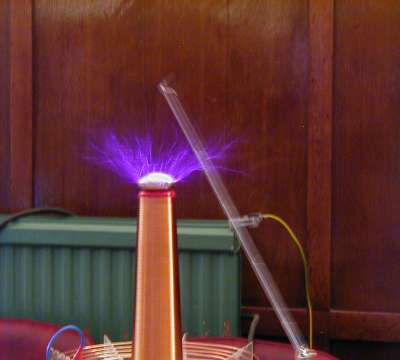
Anyway, given the above conflict of labels, I of course started to ponder how I might prepare barbecue and retain my Mad Scientist Street Cred. The answer, of course, is to build an overly complicated device to barbecue for me. Naturally, the answer is a Tesla coil:


However, this Tesla coil is cooking hot dogs in a row. That's the voltage arcing between the hot dogs that you can see flashing in the lower right quadrant of that video. I also remember that in the hometown of Dumpling Toaster (i.e., Young Toaster) there was a hot dog stand guy who electro-cooked the hot dogs he sold. He had a little breadboard set up with exposed metal pegs spaced a little less than the length of a hot dog. He'd impale each end of a hot dog on those pegs and run current through it until it was cooked and somewhat singed. It worked well and the end result was somewhat tasty, I mean, about as tasty as a hot dog can be.

But I don't want to Teslacue hot dogs. I want to barbecue whole motherfucking chickens and turkey breasts at once! So this brings up some practical considerations:

1) In order to cook the flesh, I'll need a complete circuit. Most of the time with Tesla coils one can come into contact with 1000s of volts because the amps are low and the circuit isn't complete. This means I'll need not just one, but two Tesla coils! However, this means that I can't just stand between them and hold the meat, because then I'd either a) get cooked as well, which I do not wish to do or b) have tachycardia and possibly cardiac arrest, neither of which seem particularly pleasant. This is somewhat disappointing, but understandable.

2) Hot dogs are made from chopped up processed meat, usually beef, pork, or turkey (fish dogs?), that has been pressed into a mold. What muscle fibers remain in hot dogs has been completely chaos-ified and as such no contractions will occur. But in a whole chicken, muscle fibers remain in their original orientation. As such, is it possible that, when zapped with thousands of volts, they'll twitch and spasm horribly and cause everyone buy me to lose their appetite, and maybe even spatter delicious barbecue sauce everywhere?

Figure B: Luigi Galvani beat me to it. But he was Italian and this was 1771, so I don't think he had barbecue in mind when he conducted these experiments. His frog legs twitched and he figured out that nerves are electrical.

I searched the Internets for information on this in barbecue, but to no avail. Based on the experiments of Luigi Galvani (above), it looks likely that they will. Gross as it may be to think of, this isn't much of a disincentive for me.

3) What is the probability that the flesh I intend to be barbecue will instead be reanimated into horrific, yet tasty, zombie barbecue chickens? I think that, so long as the flesh has been deceased for a sufficiently long time, say, a week refrigerated, that no reanimation would occur because the cells of the flesh would be far too degraded to jump up and wreak evil. However, it is also possible that this effect could be desirable, especially should I wish to ever conquer Kentucky (which is unlikely in any event).

4) Cornflower + cayenne = purple barbecue!

5) Who wants to come to a barbecue? I'll even make some without heat (= only 1% cayenne powder) for the wusses out there.

09 March, 2009

Verrückte Wissenschaft im Weltraum!

Natürlich folgt es, dass, wenn mann einer verrückte Wissenschaftler werden will, mann auch eine grosse Intresse an die Kraft und den Macht des Weltraums, so lang als mann die kontrollieren und nützen könnt, haben wird! So ich finde es nun sehr gut, dass die ESA eine Mondbasis bauen will. Verrückte Wissenschaft ist natürlich immer ein bisschen weiter fortgeschritten als normale Wissenschaft, aber zum besten meines jetzige Wissen sind keine verrückte Wissenschaftler auf dem Mond für forschung, leisen, oder Sonnensystemherrschaft (es gab einen Versuch in 1987 bei Drs. Rosrt, Klage, und Lollipop, um zu nach Mars zu reisen und dann dort wohnen. Wir hörten nichts von ihnen seit dann). Bei Moment bin ich nicht sicher, ob ich enttäuscht von verrückter Wissenschaft bin, oder stolz auf normaler Wissenschaft bin...

...ach, warum nicht? Ich bin Wissenschaftler, so ich werde immer stolz auf meinen Wissenschaftkameraden, auch wenn sie forschen irgendanders als mich, scheissegal ob sie verrückte oder nicht sind.


Convenient Translation:
Mad Science in Space!

It naturally follows that, when one wants to be a Mad Scientist, that they will also have a great interest in the power and force, so long as they can control and use them, of outer space. So I find it excellent that the ESA wants to build a moon base. Mad Science is naturally always a bit father progressed than normal science, but to the best of my current knowledge there are no Mad Scientists on the Moon for research, leisure, or solar system domination (there was an attempt in 1987 by Drs. Rosrt, Klage, and Lollipop to travel to Mars than then live there. We haven't heard from then since then). At the moment I am not sure whether I am disappointed in Mad Science or proud of normal science...

...oh, why not? I am a scientist, so I will always be proud of my fellow scientists, even when then research different stuff than me, and I don't give a fuck whether they're Mad or not.

27 February, 2009

The Laws of Mad Science

The Laws of Mad Science
As set forth by the International Mad Science Judiciary Committee, April 17th, 2008 at the Lair of Raw Power in the Deep Southern Pacific (not the other Southern Pacific Lair of Raw Power).
1) Mad Scientists shall build their machines/equipment/experimental apparatus much larger and more badass* than strictly necessary for no apparent reasons other than that they have the ability and capacity to do so.

2) For each time a Mad Scientist asks the question “why?” s/he is hereby also required to ask “why not?"

3) Mad Scientists are encouraged to integrate disparate pieces of machinery into the same chassis and/or wiring schemas whenever doing so adds aesthetic value but not additional functionality [1].

4) Practicality must not be a concern of Mad Scientists at any time.

5) While Mad Scientists are expected to be creative and generate many Mad Ideas at a rapid rate, we note here that we discourage the recording of those ideas on non-Self-Destructable paper as they may be used as evidence in usurpation by assistants or in a civilian court [2].

6) Due to past security failures, Mad Scientists are forbidden from using either word or numeric puns and/or jokes as passwords, machine commands, and/or entry keys [3]. Cultural references are also strongly discouraged [4].

7) Mad Scientists should develop their own or be fluent in another’s cryptography schemas to encrypt inter-Mad Scientist communications and/or sensitive data. Alchemic symbology is now effectively banned.

8) Mad Scientists are hereby reminded to avoid putting chemical or biological samples into the same storage areas as their own food**.

9) Mad Scientists are banned from conducting human research [5]. We emphatically recommend not practicing self-experimentation (the Mad Scientists' Assistants Congress has asked that we implore you to not use them for experimentation). We condemn experiments on civilian subjects [6]. However, if you determine that a human organic system is vital to your research, please contact this body and we will provide you with zombies ad libitum.

10) Mad Scientists may not steal raw materials from cargo transports, be they naval, aerial, or land-based. This is too obvious and endangers yourself, your peers, and the continuance of Mad Science. You may, and are encouraged to, "re-purpose" abandoned or found materials.

11) Collaborations between Mad Scientists are encouraged and are required to follow the rules and procedures laid out in the Collaboration Articles of 1989 [7].

*In memorial to Sir Puj Dramke (1903-2005).
** In memory of Dr. Bartholomew Töppledigöts (1963-1999).
[1] For additional explanation, please refer to the 2005 case of "Oscilloscope inside Flow Cytometer Chassis".
[2] Dr. Ernstrüm Leipäkirja, 1888. "Bayern gegen die Furchtexperimenten Herr Doktor Leipäkirja." The state of Bavaria convicted Dr. Leipäkirja of diabolical intent and ran him out of town with pitchforks and torches. Dr. Leipäkirja was later reported (unsubstantiated) to be living and working in Puxico, Missouri, The United States of America.
[3] In 2007, 10 years of work by Drs. Pram Tiddly and Evox Evox Exox to develop artificial egg environments for embryonic chickens was destroyed when animal rights activists smashed their equipment after gaining access to their lair by guessing the password "toget2theotherside".
[4] In 2003, black hat hackers invaded the pre-sentient computer network of Hermes Plodd and reconfigured it to sell Viagra just as it was learning its first contextual words. He had used "HAL2000" as a password.
[5] The 1800s as a century led to this ban. The actions of Drs. Jekyll and Frankenstein so imperiled the continued existence of Mad Science that this ban was deemed necessary and incontrovertible.
[6] In 1974, Leroy Natty was convicted and jailed for mopping a disco dance floor with androgens solubilized in DSMO to test the effects of increased libido on the power of social mores. He was also permanantly evicted from the Mad Scientists' Association for his actions. Lest you judge him too harshly, it should be noted that reconstituted artificial human biological systems were unavailable at this time.
[7] In 1988 the collaborative laboratory space of Drs. Ruthie Blandry, Sandeep Ravapredavhanamuran and Xing Zhang were found abandoned and charred. An investigation revealed that each had been keeping data from each other, which eventually resulted in a catastrophic firefight between Drs. Blandry and Ravapredavhanamuran. Most of their bodies were recovered, while Dr. Zhang remains unaccounted for and is presumed dead.


The Laws of Mad Science are meant to be a living constitution and are reviewed and amended as needed at the annual Mad Scientist Symposium. If you have any additions, deletions, changes, or retractions that you believe need to be considered for this year's upcoming conference, please append them below and they will be taken into consideration (please also leave your identifying Mad Scientist credentials, as anonymous or unverified suggestions will be rejected wholesale).

26 February, 2009

Tesla Coils + The First Law of Mad Science

From Biopunk:
And just how small can one get a Tesla coil these days? I will be looking up more for sure, oh great uberlord of the skies...
While appealing to my megalomania is a good way to get my attention, misunderstanding the entire point of having a zeppelin is not a good way to do so. I have a zeppelin, I mean, a motherfucking zeppelin!, and I can guaranfuckingtee you than I am going to have some gianticmothefucking Tesla coils on board.

So you're really going to ask how small can one get a Tesla coil? For real?

Do you not see the title of this blog!?

Why would one even want a small Tesla coil?

This is barely a Tesla coil.

I mean, really? Even when I have explicitly noted below that Tesla is my penultimate scientific role model because he was batshit eccentric (OK, so I'm not really angry about this because I don't expect everything to get read)?

Now this is a motherfucking Tesla coil!

In short, make no mistakes about it: tiny Tesla coils are pointless, and tiny Tesla coils are stupid mad science, even if they are good electrical engineering. Good mad science always makes its machines much bigger and more badass than they strictly need to be, just because it can (this is also the First Law of Mad Science, so learn it well! I will post on the other laws of mad science at some point in the future).

Now, though, since I have just now learned that one can tune a Tesla coil to specific resonant frequencies (how I didn't know this before escapes me), I am going to go incorporate that into my zeppelin's coils.

Meanwhile, please vote on the poll to your left to appease my ego and enjoy the video below (which I post even through The Legend of Zelda: Twilight Princess is currently frustrating me because I finally beat the giganticbastardtentaclefish in an underwater fight and now I find I am stuck playing as a wolf again! Ocarina of Time, though...they'll probably never top that).

25 February, 2009

Mad Science: Zeppelin


I picked up the local newspaper this morning and, sonofamothercrap!, someone managed to snap a picture of my zeppelin! I was out piloting it around town, low, just above the trees, the freezing winter air humming gently through my 3 jet engines (they're quiet because they funnel air into dense little triangles), in "light-bending" stealth mode no less, when someone on the ground below got this picture (I don't know exactly how they got this perspective, I wasn't close to any of the high-rise buildings in town, but maybe someone in one of them has a long-range camera). I mean, it's reassuring that this photo is so blurry; my stealth features are obviously working to some degree, but obviously I'll need to work on improving them. It could be that the power draw from shooting my plasma cannon (yes, it does have a laser sighting bead, and no my floaty isn't filled with combustible hydrogen, it's got MegaHelium instead [it's fun to go to concerts and vent the floaty at the stage]) weakened my cloaking devices and allowed some light to bounce off of my hull. Maybe I'll have to be more careful and more discriminating in choosing which asshats' shoes I melt to the pavement while they're wearing them (if you intend to wage war against me [ahem, Hermitage!], I recommend you start wearing wooden shoes, like clogs, although I cannot guarantee that they won't combust). For reference, that meshy grill looking thing at the front is about 7m high.

Still, though, I've got a sweet ride, huh?

Still, not as big as this:
This is the Graf Zeppelin in flight over Danzig.

One day I will build one that big, and it'll even have an improved secondary drive train (even better than the current TurboPolka auxiliary system) and a self-contained laboratory(!), and on that day that I launch it and hover menancingly against a stormy sky...on that day...you will need new underwear, or something...and stuff...Yeah! It's gonna be awesome! Of course, I'm going to need fancier goggles and a couple of Tesla coils mounted on the rudder, just for extra (Victorian? Steampunk?) street cred.

Sometimes I think that perhaps I was born into the wrong century...but only until I remember the Internet.