Showing posts with label muscles. Show all posts

27 June, 2009

Silky Muscles

ResearchBlogging.orgYou're running through the cool woods on a hot day, barefoot as dead leaves rustle underfoot and the cold flint tickles beneath. The green leaves and kudzu blur past as you dodge beaming shafts of sunlight and the hot ground they illuminate. You scan the earth ahead for sinkholes and patches of poison ivy, but still, the chilled, humid air coiled around the trees flowing in your ears feels joyous in comparison to the sauna of the open field. You dart between two trees, then suddenly stop and gyrate wildly, windmilling arms about your face as you splutter and ick; swiping instinctually at your face to pull away the clinging threads of a spider web.

To many of us, spiders are mostly nuisances, either by dangling from a single invisible thread in the most inconvenient places or by stumbling into webs and getting their sticky strands stuck in our eyebrows such that we look like a surprised Gandalf. However, a recent publication suggests that spider silk, the material they spin webs and drag lines out of, may turn out to be much more useful that we previously thought.

Compared to contractile biological muscles, mechanical rotary motors are rather inefficient. Getting a micro-servo to function correctly in a robot arm is a difficult art of soldering and fine-tuning. In prosthetic limbs, robots, and industrial applications, there is a current need for a small, reliable, lightweight, and dependable actuator. It turns out that when spider silk is exposed to alternating extremes of ambient humidity*, it contracts much like a biological muscle and does so repeatedly. Many biological fibers (cotton, wool, etc.) can also contract in high humidity, but they can only do so once before becoming inert. This occurs because different fibers are composed of repetitive hydrophilic materials that suck up water and collapse into lower net energetic states when the water is available, as it is during humid conditions.

The really cool part of this research was the force generated by the spider silk. On a basis of equivalent mass, spider silk was found to be capable of doing 500X the work of a human biological muscle. Agnarsson et al calculated that, based on their scaling experiments with combining individual silk fibers, a 2cm diameter strand of spider silk would be capable of lifting 2tons of mass! Similar, though weaker, effects were observed in silkworm silk (which is already commercially availble).

The caveat to this, because there's always a caveat, is the degree to which the spider silk contracts. Human muscle is capable of elastic modulus (how much it can bunch up without breaking) of 30-40%, while spider sillk was found to be capable of a modulus of only ~2%. This is considerably less useful, but still cool. The researchers noted that this was all done in one particular species of spider, Nephila clavipes, and that the silk of other spider species may turn out to have more useful modulus while preserving greater scaling strength and simple humidity switch.

Let's hope that these tests are done and something found, because robots everywhere are itching for a change.

*Steps of 10% differences. Contraction was found to be irreversible after exposure to <70%>

Agnarsson, I., Dhinojwala, A., Sahni, V., & Blackledge, T. (2009). Spider silk as a novel high performance biomimetic muscle driven by humidity Journal of Experimental Biology, 212 (13), 1990-1994 DOI: 10.1242/jeb.028282

22 June, 2009

Muscle Hypertrophy (Dynamics Addendum)

A while back I wrote a post about the interactions of IGF-1 and MGF on muscle hypertrophy following mechanical stress (exercise). From that post, it could be assumed that it's all about IGF-1 and MGF, but the reality is considerably more complex than that.

It's tempting, and easy, to think of our bodies as constant and that growth is only occuring when we can see it. However, the body is continually tearing itself down and building itself back up. The entire intestinal epithelium regenerates completely, a couple cells at a time, over the course of 4 days to 1 week. Our skin is continually growing outwards and being worn away. Some organ systems, such as skeletal bone, rebuild themselves at a much slower rate while others, such as the central nervous system, are essentially immutable over the entire course of our lives. Most of the molecules that make up the body are in a continual state of flux as metabolism breaks down cellular products in adipocytes and delivers free fatty acids to the liver for oxidation into pyruvate, phosphocreatinine, or glycogen for use by skeletal muscle to do work, although this is not the only direction or only pathway in which such conversions constantly take place.

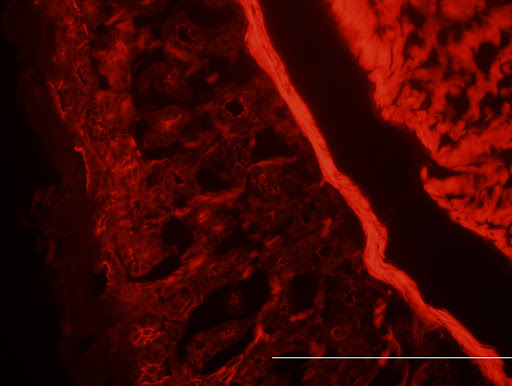
Colonic smooth muscle actin (red). The bright red strand is the smooth muscle lining the columnar epithelium of the colon (fainter chambered red). The really bright red strand is the musclaris mucosa that helps to drive peristalsis, or the sequential movement of intestinal smooth muscles to drive lumenal contents (food being digested) along the length of the gastrointestinal tract. 40X magnification, bar is 200um.

Muscles are made up of highly-organized fibers, such as the actin in the picture above. These fibers are organized into bundles that are studded with molecular motors known as kinesins that effectively run along parallel fibers. When you contract a muscle and tense it up, the fibers are dragged past each other by the kinesins to make the effective length of the muscle shorter and producing work in the form of moving whatever the muscle is attached to. In the process of this, the molecular motors burn cellular energy in the form of adenosine triphosphate (ATP) that the body makes from pyruvate molecules.

Over time as the muscle fibers get used they start to breakdown due to mechanical wear and tear (the initial burn from a workout is due to accumulation of calcium from anaerobic respiration; the soreness the next day is due to injured muscle fibers). The order of the molecules in the fibers starts to break down, and it's much cheaper in terms of energy used for the body to break down the worn-out muscle fibers and replace them with new fibers than it is to just repair them. As such, skeletal muscles are in a continual flux of breakdown and new fiber synthesis. This dynamic process that continually renews our muscles is not only completely normal, it's advantageous. Genetic experiments with mice have shown that deleting the gene that encodes myostatin, a protein strongly implicated in muscle breakdown, results in massively muscled mice who aren't any stronger than their scrawny companions that still have myostatin. Deletion of myostatin arrests muscle breakdown, but also leads to hypertrophy of those muscles primarily through retention of damaged and useless muscle fibers that add absolutely nothing to the ability of the muscles to perform work (strength).

In relation to food, the breakdown and building of muscles, which are really just facets of the catabolic and anabolic states of metabolism, can be classified more simply as muscle protein breakdown (MPB) and muscle protein synthesis (MPS). Put simply, muscles will shrink when the rate of MPB exceeds that of MPS and vice versa. The body increases MPB when blood sugar and insulin levels are low and the bodily stores of glycogen in liver and skeletal muscle have been depleted. Although fatty acids are also mobilized for energy from fat tissues, the net effect of this is that the body begins to slowly eat at its skeletal muscles to keep going. The body also pulls acidic or basic amino acids out of muscle proteins as needed to help regulate blood pH, which has to remain within a narrow range for us to survive. After eating, and for 4-6h afterwards, the body decreases MPB and increases MPS such that new muscle fibers are built. How we work out, the spacing of our meals, and even the composition of those meals all influence the efficiency with which muscle protein synthesis occurs. For what it's worth, branched amino acids such as valine, leucine, and isoleucine are absorbed across the brush border of the duodenum and into the blood stream at a faster rate than other free amino acids.

The primary lesson of all of this is that bodily flux is entirely normal. I know that when I first started trying to gain weight I obsessively checked the scale everyday and would be disappointed when it registered a 2kg loss over the course of a day, and astounded when it would suddenly report a 4kg increase in 1 day. The reality is that one's immediate weight, and muscle mass, are determined by a large number of factors and unless we are trying to be super-athletes we shouldn't sweat them too much. Variation is normal. The body already has flux down and we don't even have to think about it for it to occur.

P.S. - Scicurious of Neurotopia has published an excellent introduction to the mechanics of neurotransmission, which are quite relevant to how nerve signals are transduced to musclar action through neuromusclar junctions.

[Sources for this post included what I remember from a few old textbooks (primarily Griffin and Ojedas' "Textbook of Endocrine Physiology", Vander, Sherman, and Lucianos' "Human Physiology", maybe some Alberts et als' "Molecular Biology of the Cell", and a wide scattering of abstracts I remember reading, but not saving.]

08 April, 2009

Muscle Hypertrophy

ResearchBlogging.orgHaving somewhat recently realized that I don't want to have the awesomely statuesque physique of a stick figure for the rest of my life, I began working out (before and after picture below). I still have no idea how to use most of the equipment in the gym and I'm not going to ask Pikkuveli (="little brother") how to use it just because he has ~130kg of muscle to my paltry ~60kg (we're also the same height: ~2.07m). But I am willing to ask where muscles come from.

So I hit up Current Opinion in Pharmacology and managed to learn something: muscles come from your liver.

Kinda weird, huh?

So here's how it more-or-less works:
1) ghrelin gets made by the fundus of your stomach
2) and binds to GHS-R in the arcuate nucleus of the hypothalamus, which then releases growth hormone in response
3) which travels to the liver and gets it to make up some insulin-like growth factor (IGF-1)
4) which then enters the systemic circulation and
5) acts in concert with local mechano growth factor (MGF) at the skeletal muscle to increase net protein synthesis and myotubule formation

But here's what's really cool and elegant about it: IGF-1 and MGF get made from the same mRNA transcript, just spliced up differently in different tissues.

Figure A: Electron micrograph showing a neuromuscular junction. M = muscle, T = axon terminus, arrow = junctional folds with basal lamina. Scale bar = 3um. Source: Wikimedia Commons.

MGF is produced by skeletal muscle tissue in response to mechanical stress (lifting heavy stuff) and cellular damage (the burn the day after working out) and acts in a paracrine and autocrine manner in and on satellite cells that hang out outside the membrane enveloping the muscle fiber. Satellite cells are mononucleated muscle stem cells. MGF tells them to proliferate and make more of themselves. But in order for this increase in satellite cells to translate into muscle growth, IGF-1 (IGF-1Ea, specifically) has to come along and get the proliferating satellite cells to cross the muscle fiber membrane and merge with each other to form a mature, multinucleated myotubule capable of contracting.

Conveniently enough, MGF levels are increased in skeletal muscle for ~2 days post-workout before tapering off. IGF-1Ea levels are increased for longer than that, so there is a sort of 2-phase muscle growth mechanism at work that smartly regulates itself. If MGF levels didn't taper off, satellite cells would keep proliferating and differentiating to myotubules and we'd drown in overgrowing buffness.

But, it's not quite so simple as that. Skeletal muscles are in a continual state of flux as they tear themselves apart and build themselves back up. The body can stash away amino acids in skeletal muscle or grab them back out as needed to help regulate serum pH. Muscle turnover also helps get rid of old, damaged myotubules and replace them with shiny, new, functionalier ones. Apparently this process takes about 2 weeks (I'm thinking maybe this is a minimum interval for exercise to maintain physique?) and heavily involves myostatin. Natural myostatin knockout mutants include Belgian blue cattle.

Figure B: A Belgian Blue bull (on the right).

Laboratory knockouts of myostatin in mice confirm that no myostatin to help muscle turnover along leads to increased muscle growth, but does not increase strength at all. This is thought to be due to increased accumulation of nonfunctional protein in muscle fibers.

Figure C: Toaster's physique before beginning exercise (left) and after (right).

So right about now my latest MGF pulse should be slowing and hopefully my IFG-1Ea is kicking in to get the new satellite cells that surely must be teeming in my shoulders and triceps fusing into functional new muscle. In the meantime, however, raising my elbows anywhere above shoulder level is rather more painful than I thought it might be. Maybe I shouldn't have done quite so many pull-ups, lat pull-downs, and tricep dips...


GOLDSPINK, G., WESSNER, B., & BACHL, N. (2008). Growth factors, muscle function and doping Current Opinion in Pharmacology, 8 (3), 352-357 DOI: 10.1016/j.coph.2008.02.002