17 March, 2009

How Deeply Do You Focus the Lens?

I have another post brewing, basically the other shitkettle that's stinking up my life at the moment. It's even written. However, it's dark and deeply personal, and I'm still trying to figure out just how much one can/should let leak from behind the mask of their blogonymity.

So, dear apprentices, how do you balance connecting with your readers as more than a witting wordy pontiff and feeling exposed?

I'm aware that each of us must choose how much of our real lives to reveal. I intend to write more than mere Mad Science Lulz, but at the same time, do I want to invite you all to examine the light at the end of the tunnel between my ears? This is the question I am currently wrestling with, and perhaps your experienced wisdom/bidness could lend me a hand.

15 March, 2009

Useful Uses for Anger

I have been rejected by all the institutions to which I applied for graduate studies.

Family and friends keep asked me if I was OK about it, and I told them that yes, I'm just peachy because there's always next year (there is, right?). But I'm not. I guess in reality I'm kind of torn up by this, as well as mightily pissed off, but I don't tell them this because I don't want them to worry and I don't want them to see just how much I care because then I think they'd share in my disappointment. I have an uncle or two in Scandinavia that I think went to graduate school, but I'm fairly sure that they went for professional degrees. But of the family that I grew up with here in the States, no one else has ever gone to grad school. And they're all looking at me expectantly smiling and prodding me on, expecting me to set a gleaming example for the younglings of my generation (I'm the eldest of the current generation). And in addition to this pressure, I put myself under more, muttering fervently the exhausting mantra: "Do more, be better!"

Failing to get into grad school, failing to even get so much as an interview, is not doing more or being better. And because of this I'm not so much pissed off at the institutions (they had very few spots, I understand) as I'm angry at myself. Angry at not selling myself better. Disappointed that I didn't find the wonderful advice that Eppendork, Dr. Isis, PhysioProf, Ambivalent Academic, et al have shared with the world via their blogs.

Part of this, I know, is that I am sick of being stuck in small-city Midwest, sick of the same grey weather, sick of the same fucking patterns of everyfuckingthing. Especially sick of the bougie locals who think science is just cute. But it's also largely that I'm restless, I want to move on, and as far as I am willing to see, the only direction to move on in is up.

But a larger part of it is that I am having a hard time separating my self-worth as an aspirant scientist from being rejected.

I want so badly to tear through some new applicable literature*, to sink my teeth into a new set of experimental skills and shake the living shit out of them until they splatter beautiful data everywhere, to learn further and deeper and have peers with whom I can discuss it all, to design and fail and design and fail again and again until I have hammered out elegance! Most of all, I want to be challenged!

The anger I currently hold is of a useful sort. I can use it as fuel. It was anger at being trapped in an endless surburban tract with people who cared more about their lawns' green-ness than the dynamics of molecular orbitals that motivated me to do well in high school so I could get the fuck out of the South**. It was anger at national politics that caused me to harrass the university newspaper's cartoonists until they let me into their club, and that later got me condemned by Catholics, fundamentalists, and Republicans across campus.

So it is this anger, me being mad at being mediocre, that will have me kicking in doors this coming summer and contacting specific professors instead of relying on the sparkliness of specific programs. It is this anger that will have me dissecting my essays several more times, and maybe even being more careful with whom I ask to write letters on my behalf. I am going to beat down the door to academia, even if I'm not sure I want a post-postdoc career in it, with manners and all the charisma*** I can muster. I'll keep the anger to myself, but I'm sure as hell going to bend it to a useful use.

*I frequently read papers on topics other than my projects, but it's always kind of bittersweet because I don't get to use them for anything.

**At the time I thought that I was getting out of the Midwestern mindset (I lived in the interface of Midwest and South) when I came to Michigan, but it turns out that Michigan was just as dopey and the food wasn't even nearly as good. Seriously, why do Michigan tomatoes taste like nothing?

***Note to self: get charisma. Best strategy likely to be attaching my name to a celebrity like a male anglerfish, but much handsomer.


Even Toaster's anger contains polka.

13 March, 2009

Poll! Vanity! Toaster's Face!

Figure A: Toaster (after combing his hair).

For the boosting of my own ego and infrequent vanity, I included a response for "I'm only here because I think Toaster is hot" in the poll to your left. I didn't expect much of a response, but I did not expect to be beaten 10 to motherfucking 1 (whoever that 1 is, thank you) by motherfucking bunnies! I guess, honestly, I should have known better than to tempt the Internet with bunnies. But still, I looked at the picture of me that was attached to this blog, with full PPE and fresh haircut on, and realized that maybe this disparity is because that photo looks like a pile of blue with some hair sticking out.

Figure B: Toaster models most of the PPE in the lab (also: prepared for zombie apocalypse).

So I provide for you this picture above (very top, not immediately above), of myself, to influence your opinions. Don't vote for the sake of my ego or vanity; don't vote because of my mild ranting; no, vote for my creepy lopsided stare and week-long invisible stubble!

Vote early!

Vote now!

Vote multiple times!

I'll find some connection to science here somehow sometime later (feel free to do so yourself, though).

12 March, 2009

Faces

I gave my lab computer a face.


Now it won't turn on.

Granted, it has had a face for 6 months (at least), so I can't definitively say that this is what caused it to fizzle, but still. It has been freezing once a day for the past couple of months, which has necessitated that I force a shut down and reboot. But now I'm not even getting anything and it's overheating.

Seriously, computer, what the fuck? I'm nice to you. I keep your hard drive relatively organized, I keep my data in the cloud instead of making you carry it. I turn you off every night so you can rest. Yes, I play a lot of music with you since the other other computer blew some capacitors, but that doesn't mean you're just a dressed up jukebox! So what is it then, computer? Has it been the electrical work the plant crew has been doing around here lately with the frequent blackouts at odd hours of the night? Did I dress you with too many Post-It notes that you sweated yourself into exhaustion? Did you want a prettier face? You should have told me, because, frankly, this is a shitty way to get my attention.

And this CRT monitor is already giving me a headache.

Therefore, computer, I ask of you: why?

11 March, 2009

Not-So-Mad Science: Shiga Toxin Increases EHEC Intestinal Colonization

This post is part of Cyber Journal Club with Science Bear and R.E.S.E.A.R.C.H.E.R.S..

Figure A: EHEC + other stuff on sorbitol MacConkey Agar. Most EHEC cannot ferment sorbitol and on SMAC agar it will grow translucent. Other stuff pictured here can ferment sorbitol and as such is pink because it has raised the local pH and tripped the pH indicator in MacConkey plates.

(For background, I've discussed Shiga toxin and EHEC in greater detail before.)

EHEC = enterohemorrhagic Escherichia coli O157:H7
Stx = Shiga toxin


ResearchBlogging.orgBriefly, EHEC is a food-borne enteric pathogen that has been evolving over the past 2 decades from a minor poop-tainted beef-borne pathogen to a more severe and flexible pathogen that is still found in beef, but now also on spinach (even growing inside the spinach). Primary sequalae of EHEC infection are intestinal cramping and diarrhea progressing to hemorrhagic colitis. This may usually be resolved with careful and selective use of antibiotics (antibiotics that cause any DNA stress will just make it worse). However, in some cases EHEC infection progresses to hemolytic uremic syndrome (HUS), which includes hemolytic anemia (lysed RBCs), uremia (acute renal failure), and thrombocytopenia (low platelet count). HUS can involve microangiopathic inflammation of the kidneys, bowels, and CNS, which can result in long-term dysfunction.

Epidemiologically, HUS is closely associated with infection by Stx-producing E. colis. As such, and because Stx is directly cytotoxic to in vitro renal cell cultures, Stx has been implicated as a primary causative agent of HUS. Stx is a AB5 N-glycosidase that shuts down protein synthesis by binding to and disabling ribosomes. Stx is encoded by a lambdoid prophage integrated into the EHEC chromosome that is inducible by DNA stress, specifically RecA in the SOS response. RecA cleaves the cI/LexA repressor on the lambdoid genes and allows transcription. Shiga toxin is thought to be released primarily when the induced host cell is lysed by prophage proteins. It has been observed that Stx+ EHEC results in more severe pathologies than Stx- EHEC.

Robinson et al (below) has found that EHEC adherence (in vitro) and colonization (in vivo) are increased in the prescence of Stx2. They used the Relatively Straightforward Common Biotech Method:
Step 1: Break it and compare that to that that ain't broke, then supplement the broken stuff to the level of that which ain't broke and compare again. If breaking it resulted in nothing, or less, happening, then what you broke might be causing that effect to happen in the first place and you may develop sweaty palms.
Step 2: If supplementing what's broken to non-broken levels restores the effect, then what you broke is probably causing that effect and you may start fidgeting uncontrollable.
Step 3: But, if you've also broken other related stuff and not seen the same pattern, then you can say that what you broke is causing it to happen (to the best of our current knowledge!) and you may then do a happy marshmallow dance of victory.
So Robinson et al took a normal Stx+ EHEC (strain 86-24) and made a mutant Stx- EHEC (strain TUV86-2, checked culture supernatant for cytotoxin activity: negative), then made them both into glowy mutants by adding constitutive GFP (this was smart for reasons we'll come to shortly). Then they grew up some HEp-2 cells in culture and let both strains loose on it in separate wells, which resulted in more 86-24 sticking than TUV86-2 (step 1). This same pattern was also observed in mice infected with both strains: 86-24 colonized the gut better than TUV86-2. They also checked microcolony formation and the degree of actin condensation (both characteristics of EHEC adherence), which was important because it demonstrates that TUV86-2 wasn't fundamentally different than 86-24 and so could be compared. So naturally, Robinson et al's next logical step was to add some Stx2 to the TUV86-2 to see if it could restore 86-24 adherence and colonization. It worked (step 2). Interestingly, in TUV86-2 + Stx2 groups, the proportion of HEp-2 cells to which the bacteria adhered remained the same, but the bacteria/cell increased (not significantly). And to prove that step 2 worked, they also repeated this with a neutralizing anti-Stx2 mAb and compared that to normal mouse serum. The TUV86-2 + Stx2 + anti-Stx2 mAb had similar adherence and colonization patterns to TUV86-2 alone. The normal mouse serum had no effect on the effect of Stx2.

So what was the Stx2 doing in the lumen that was causing increased adhesion? They looked at bacterial adhesion factors (Tir, intimin, et al) after incubation with Stx2 and found no change (however, they used Western blot for this; I'd have accepted this more readily if they'd also done a bacterial mRNA profile as it is possible that the incubation time was not long enough for a signal change in transcription to become evident at the level of proteins; also: step 3). So they looked at putative adhesion factors on the host HEp-2 cells, namely: nucleolin. Incubation of HEp-2 cells with Stx2 resulted in a dose- (and, kinda, time-) dependent increase in the cell surface expression of nucleolin, which was statistically significant even with just 10ng/ml Stx2 for 2h (for contrast, 100ng/ml Stx2 for 2h resulted in a significant increase of nucleolin). However, I would have again have preferred to see some mRNA analysis of the host cells. Not because I suspect there could be a significant effect from an incubation time artifact (at least, not after 24h), but because the data would have been very interesting. Is Stx2 increasing transcription of nucleolin or just an increase in the surface display thereof? mRNA data could have answered that. Also, why not wash the crap out of the cells to remove any residual media-borne Stx2 and check to see if there is any Stx2 inside the cells (either with a GFP-tagged Stx2 or ELISA on cell lysate)? Stx2 has been shown to enter gastrointestinal epithelial cells (in culture) nonspecifically through macropinocytosis, but is it doing something specific once its in there, if it's even getting in (because the macropinocytosis has only been observed to happen in some specific cell culture lines)? Is Stx2 reacting with a surface HEp-2 receptor or is it some internal effect? Is Stx2 binding nucleolin itself and causing autoaggregation at the surface (FRET!)?

All in all, an interesting paper, but for me it raised many more questions than it answered.
Robinson, C. (2006). Shiga toxin of enterohemorrhagic Escherichia coli type O157:H7 promotes intestinal colonization Proceedings of the National Academy of Sciences, 103 (25), 9667-9672 DOI: 10.1073/pnas.0602359103

10 March, 2009

How Do Mad Scientists Grill?

Figure A: Like this.

I am Toaster, and I enjoy barbecue immensely. If it's been fried and then barbecued, it's even better (can Toaster has OKRA and CORNBREADS?). However, I am also a Mad Scientist, and connoisseurs of barbecue are generally known as rednecks. These labels are not exactly compatible. While it is true that I will quickly and invariably develop a red neck if left out in the sun for too long, I do not drive a pick-up truck or think that country music is palatable. I have never gone turtle stomping, square dancing (although my high school required us to learn how to do so in gym class), slough hollerin', swamp boating, or had a moustache. However, in the interests of disclosure, I must admit that I have occasionally been known to let slip a "ya'll" or an "ain't", sometimes even a "y'all'rnt".

Ahem. Don't judge.

Anyway, given the above conflict of labels, I of course started to ponder how I might prepare barbecue and retain my Mad Scientist Street Cred. The answer, of course, is to build an overly complicated device to barbecue for me. Naturally, the answer is a Tesla coil:


However, this Tesla coil is cooking hot dogs in a row. That's the voltage arcing between the hot dogs that you can see flashing in the lower right quadrant of that video. I also remember that in the hometown of Dumpling Toaster (i.e., Young Toaster) there was a hot dog stand guy who electro-cooked the hot dogs he sold. He had a little breadboard set up with exposed metal pegs spaced a little less than the length of a hot dog. He'd impale each end of a hot dog on those pegs and run current through it until it was cooked and somewhat singed. It worked well and the end result was somewhat tasty, I mean, about as tasty as a hot dog can be.

But I don't want to Teslacue hot dogs. I want to barbecue whole motherfucking chickens and turkey breasts at once! So this brings up some practical considerations:

1) In order to cook the flesh, I'll need a complete circuit. Most of the time with Tesla coils one can come into contact with 1000s of volts because the amps are low and the circuit isn't complete. This means I'll need not just one, but two Tesla coils! However, this means that I can't just stand between them and hold the meat, because then I'd either a) get cooked as well, which I do not wish to do or b) have tachycardia and possibly cardiac arrest, neither of which seem particularly pleasant. This is somewhat disappointing, but understandable.

2) Hot dogs are made from chopped up processed meat, usually beef, pork, or turkey (fish dogs?), that has been pressed into a mold. What muscle fibers remain in hot dogs has been completely chaos-ified and as such no contractions will occur. But in a whole chicken, muscle fibers remain in their original orientation. As such, is it possible that, when zapped with thousands of volts, they'll twitch and spasm horribly and cause everyone buy me to lose their appetite, and maybe even spatter delicious barbecue sauce everywhere?

Figure B: Luigi Galvani beat me to it. But he was Italian and this was 1771, so I don't think he had barbecue in mind when he conducted these experiments. His frog legs twitched and he figured out that nerves are electrical.

I searched the Internets for information on this in barbecue, but to no avail. Based on the experiments of Luigi Galvani (above), it looks likely that they will. Gross as it may be to think of, this isn't much of a disincentive for me.

3) What is the probability that the flesh I intend to be barbecue will instead be reanimated into horrific, yet tasty, zombie barbecue chickens? I think that, so long as the flesh has been deceased for a sufficiently long time, say, a week refrigerated, that no reanimation would occur because the cells of the flesh would be far too degraded to jump up and wreak evil. However, it is also possible that this effect could be desirable, especially should I wish to ever conquer Kentucky (which is unlikely in any event).

4) Cornflower + cayenne = purple barbecue!

5) Who wants to come to a barbecue? I'll even make some without heat (= only 1% cayenne powder) for the wusses out there.

09 March, 2009

Verrückte Wissenschaft im Weltraum!

Natürlich folgt es, dass, wenn mann einer verrückte Wissenschaftler werden will, mann auch eine grosse Intresse an die Kraft und den Macht des Weltraums, so lang als mann die kontrollieren und nützen könnt, haben wird! So ich finde es nun sehr gut, dass die ESA eine Mondbasis bauen will. Verrückte Wissenschaft ist natürlich immer ein bisschen weiter fortgeschritten als normale Wissenschaft, aber zum besten meines jetzige Wissen sind keine verrückte Wissenschaftler auf dem Mond für forschung, leisen, oder Sonnensystemherrschaft (es gab einen Versuch in 1987 bei Drs. Rosrt, Klage, und Lollipop, um zu nach Mars zu reisen und dann dort wohnen. Wir hörten nichts von ihnen seit dann). Bei Moment bin ich nicht sicher, ob ich enttäuscht von verrückter Wissenschaft bin, oder stolz auf normaler Wissenschaft bin...

...ach, warum nicht? Ich bin Wissenschaftler, so ich werde immer stolz auf meinen Wissenschaftkameraden, auch wenn sie forschen irgendanders als mich, scheissegal ob sie verrückte oder nicht sind.


Convenient Translation:
Mad Science in Space!

It naturally follows that, when one wants to be a Mad Scientist, that they will also have a great interest in the power and force, so long as they can control and use them, of outer space. So I find it excellent that the ESA wants to build a moon base. Mad Science is naturally always a bit father progressed than normal science, but to the best of my current knowledge there are no Mad Scientists on the Moon for research, leisure, or solar system domination (there was an attempt in 1987 by Drs. Rosrt, Klage, and Lollipop to travel to Mars than then live there. We haven't heard from then since then). At the moment I am not sure whether I am disappointed in Mad Science or proud of normal science...

...oh, why not? I am a scientist, so I will always be proud of my fellow scientists, even when then research different stuff than me, and I don't give a fuck whether they're Mad or not.

05 March, 2009

Not-So-Mad Science: Patchiness in Asthma

ResearchBlogging.orgIt’s a beautiful spring day, the first warm and sunny day of the year and the snow has finally melted. So naturally, you’re outside, enjoying it. The birds have reemerged from their hiding places, and all the plants are heavy with green and bloom. The whole earth smells clean, as though the snow and sleet somehow scrubbed the very grass and have made it shine, even if it is still brown and crinkles underfoot. Off in the birdsong distance, you can see the tree boughs tossing in the breeze. After so long cooped up inside with nothing but TV and the Internet, you ignore it. But then you suddenly notice that you’re struggling to pull air into your lungs while the air trapped deep inside is beginning to burn. You try to form words for help, yet nothing but a faint wheezing gasp comes out as you can literally feel your throat closing around your words like a wet, desperate fist. At this point you’re hunched over, chest heaving, desperate to yank the slightest bit of oxygen into your lungs that feel like a wet towel tightening slowly around your wildly beating heart. You clutch at your throat and a detached piece of your rapidly dizzying mind notices that your hands are shockingly cold. The crinkly grass rushes up and catches you as you strain, tendons taut and eyes watering, for any breath at all, barely enough of you left to wonder where you left your inhaler. But it’s there, digging into your hip in the pocket of your coat. Your lizard brain swats what remains of consciousness aside, manages to feebly flop you over, dig the inhaler out, and jam it between bluing lips. That first puff hits your throat cold and gritty, but it opens a little, just a bit, enough for the tiniest of breaths, which stings like salt. The second puff gets you going a bit more, and finally a third puff gets at least 1 bronchiole knocked wide open. Spreadeagled and panting hard on the grass, you watch the clouds scud above and silently curse the Ur-flower that first thought to make pollen. What a motherfucker that little bitch was. But at least you’re alive to even curse it.

***

Although we know quite a bit about the gross pathophysiology of asthma and, in most cases, how to treat it (acute and prophylactic), there remains quite a bit we do not know*. And there have been several well publicized epidemiological studies over the past 2 decades that indicate that asthma and allergy are increasing in prevalence across all socioeconomic lines. And the challenging and perhaps most frustrating part (and this, to me at least, is what makes it so intriguing) is that no one really knows why asthma and allergy (referred to together as atopy) are increasing, although we have hypothesizes ranging from diet, the hygiene hypothesis, perturbed gut microbial ecology, and general organic and synthetic chemical pollution.

First, let’s talk about the structural physiology of lungs. Anyone who has ever dissected a mouse knows that the lungs collapse into a wet pink mess pretty much as soon as the organism dies. This is because mice have spongy lungs (as opposed to “simpler” bag-like lungs in many animals) like humans. This is also because lungs are mostly soft tissue with air-filled tubes running throughout, somewhat analogous to Jello with holes drilled through it (though I don’t know why anyone would drill holes in Jello, if it’s even drillable [I may need to empirically test this]). The trachea branches off into the main bronchi, which each branch into lobar bronchi. These then branch into tertiary bronchi and form bronchopulmonary segments separated by connective tissue (lobes, essentially). Inside the bronchopulmonary segments the bronchi are called segmental bronchi, which then divide into primary bronchioles before dividing further into terminal bronchioles. And because this isn’t yet enough (think about it: each stage of segmentation increases the surface area per given unit volume quite efficiently, like a Sierpinski triangle), the terminal bronchioles branch into respiratory bronchioles branch into alveolar ducts end in alveolar sacs that contain the alveoli. Alveoli are where gas exchange happens via the blood vessels that cover most of their surface area. As the airways branch further out, rigid supporting cartilage decreases and smooth muscle increases. This is important to note for later, as are the observations that each lung does not branch perfectly symmetrically.

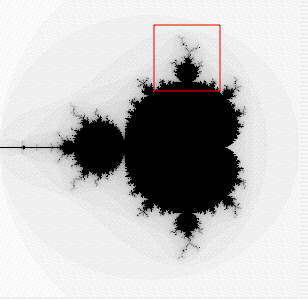
Figure A: 2 ways to visualize the branching of the bronchi. Mandelbrot set visualization (top) and fractal tree (bottom).

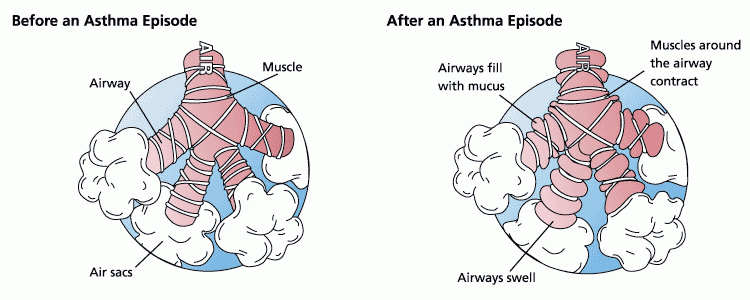
Second, let’s talk about the pathophysiology of asthma. The possible causes and/or triggers of asthma warrant an entire series of posts by themselves, so they won’t be discussed here. Asthma occurs when the lungs aren’t providing adequate respiratory exchange due to constricted air flow volume (also referred to as tidal volume) and the levels of oxygen in the blood begin to fall; asthma is generally treatable with drugs, this is what clinically differentiates asthma from COPD and/or some ARDS. Reduced tidal volume is primarily thought to be a direct consequence of increased smooth muscle activation. Smooth muscles can be triggered by a wide variety of extrinsic factors and the resulting asthma attack can range from mild wheezing to complete respiratory failure and death. Long-term pathophysiological manifestations include scarring of the lung airway epithelium, localized sustained inflammation, and a reduced baseline tidal capacity, which are thought to be due to recruitment of immune system effector cells into the underlying tissues (which in turn cyclically drives more inflammation).

Figure B: Like that (although this .png has been squished a bit).

Finally, then, to the paper. A computational model of a single terminal bronchiole that included the physics of positive airway pressure inside the lumen space, the tension of underlying parenchymal upon bronchioles, and the constriction caused by smooth muscle activation was integrated to simulate a whole lung by using a Mandelbrot-like structure that reflects the serial branching of airways. This model assumes constant tidal volume and rate and neglects gravity-dependent lung effects as would occur in the deeper lungs. It also ignores the effect of diaphragm muscles on lung function. Obviously, in real life we breathe harder when we’re winded and the air deep in our lungs has to contend with gravity more than air in our upper lungs, and we also use muscles to breathe, but simplifications are necessary to make modeling a sane endeavor.
And now for the metaphorical vehicle: Imagine you’re standing on a tightrope with someone else at some distance away from you, say, farther than you could throw a tuba. If you lose your balance, you’ll swing about to try to regain it, and doing so will move the rope you’re standing on, which will then result in the other person having to move to keep their balance. If you don’t quickly recover your balance and steady the rope, either you’ll fall or the other person will have to work harder to stay on the rope and continue to amplify your instability.

Figure C: Don't try this at home. Go somewhere more dangerous first.

Unfortunately, falling off the rope doesn’t really happen in asthma attacks (unless you think of that as a piece of lung shutting down). Sure, whole chunks of lung seize up and stop providing adequate ventilation, but this is patchy and even then those patches still contain smaller bits that still work as they’re supposed to. But it is the amplification of instability that leads to the progressive and terrifyingly fast clamping shut of airways in an asthma attack. Section A shuts down, so Sections B, C, and D will have to work harder to compensate. Compensation will involve greater intrabronchial airway pressure, which the normally functioning lung interprets as bad and tries to compensate for in the opposite direction by activating smooth muscle, so smooth muscle activation and airway constriction can spread rapidly from Section A to B to C in sudden and catastrophic sequence even if only a little tiny bit of Section A started the whole thing.

The computational model used in this paper found that catastrophic shifts as described above don’t really happen unless some degree (~1%) of heterogeneity in lung response to constriction/smooth muscle activation is included. If the computational model was allowed to be completely symmetrical and if all lung tissue responded in exactly the same way, then nothing spectacular happened.

While I find the computational modeling stuff to be fascinatingly awesome, that’s not all they did. They also got mild to moderate asthmatic volunteers to inhale isotopic nitrogen gas inside of a PET machine during a chemically induced asthma attack to map where the gas was going (those were very brave asthmatics). In poorly functioning lung, iN2 would be trapped and remain visible on the PET while normally functioning, or lung hyper-functioning to compensate, lung would clear it quickly. These PET results validated their modeling outcomes in that asthmatic events are patchy in that neighboring bronchioles are more likely to become distressed than distant bronchioles, though not absolutely in that the patchiness of poorly ventilated lung was itself patchy (mirroring computationally induced heterogeneity). Furthermore, these findings were clinically relevant because only normal- or hyper-functioning lung remained open during the asthmatic event, which suggests that inhaled anti-inflammatories may be being delivered primarily to the lung epithelium that needs it least.

Research Cited:
Jose G. Venegas, Tilo Winkler, Guido Musch, Marcos F. Vidal Melo, Dominick Layfield, Nora Tgavalekos, Alan J. Fischman, Ronald J. Callahan, Giacomo Bellani, R. Scott Harris (2005). Self-organized patchiness in asthma as a prelude to catastrophic shifts Nature, 434 (7034), 777-782 DOI: 10.1038/nature03490

*From my perspective as someone who doesn't actually do atopy research...yet, anyway. Therefore, if I am flatulating ignorance and posing it as wisdom, feel free to correct my mistakes in comments.

NOTE: This is my first post for the Cyber Journal Club that Science Bear is organizing. R.E.S.E.A.R.C.H.E.R.S are also participating. My goal is to post every Wednesday and apparently Science Bear is going to be posting 2 Wednesdays a month. Feel free to join in by commenting or posting your own (we'll ping you).

03 March, 2009

Mad Scientist Etiquette

[There will be more Not-So-Mad Science {aka, Real Science} tomorrow!]

Naturally, since Mad Scientists have Laws, it follows that we will also have a semi-standardized guidebook for Mad Scientist Etiquette. This guidebook is not about rules or standards per se, it's more of an orientation pamphlet for aspiring Mad Scientists. I present some selections from the Etiquette Brassiere below. Suggestions are welcomed, but stupid questions will be shot (the questioners will just be chased about by robots specially built for that task). Composite-numbered items have been banned.

Tip #7:
A proper Mad Scientist never merely orchestrates the downfall or demise of their enemies. Instead, they compose a whole motherfucking* symphony with multiple thematic overtures and movements.

Tip #11:
A proper Mad Scientist laugh is indistinguishable from an Evil Genius guffaw to unpracticed ears, but the two are distinct to a practiced ear, although it is physically possible to produce both at the same time. Recordings of both can be provided to you upon request.

Tip #13:
Remember your assistant's birthday, especially if you have accidentally horrifically scarred or maimed him/her in the last year.

Tip #23:
It is both wise and polite to maintain a ready supply of spare parts for assistants and guests.

Tip #71:
Flip-flops are an excellent shoe for Mad Scientists in tropical climates because they can be used to swat mosquitoes, assistants, and malfunctioning machinery.

Tip #83:
Wipe your feet when coming inside from out.

Tip #97:
If you must pass gas, please do so away from Bunsen burners.


*Word!

02 March, 2009

Wacklegrot + Whuzzafux

Today, I have not just one, but two (!) additions to the English language for your grokking pleasure (which somehow sounds like something one would have to pay to watch, but that's not how I mean it, I think): Wacklegrot and whuzzafux.

WACKLEGROT
1) noun; category of very shiny objects of a puzzling and vague nature that can and invariably do distract the easily distracted for hours on end to the exclusion of all other attentions.
2) noun; legendary fabled focuser of attention for the easily distracted, for whom it will make concentration easy if its puzzling nature is solved.
3) noun; derogatory term used to describe those easily distracted by shiny objects.

WHUZZAFUX
1) noun; disappointing lulz
2) verb; to be surprised by something very shocking and random


Once again, English language, you are welcome. Now I am going to run away before you blurf me for being so irreverent.