04 February, 2009

Cookies

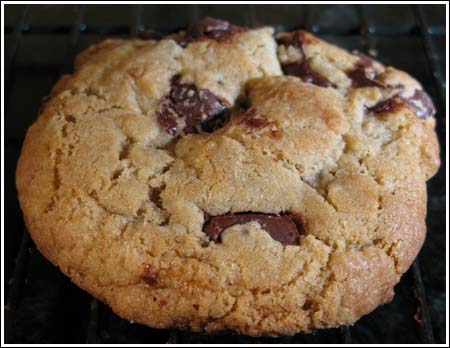
Figure A: This IS a cookie (we'll come to the converse later).

Today I am annoyed. I'm tired of not being taken seriously and having to explain myself to collaborators who don't bother reading my Methodology write-ups (do I seriously need to start diagramming these things in my spreadsheets?) to understand the data I share with them. I am tired of collaborators who keep coming around to our isolated little lab looking for results when it's too early for anything to have grown. I am a technician, and yes, I am powerful, but I am not a Master of Timespace. I cannot force bacteria to grow faster, and nor can I make a predict the outcome of the experiment from the first sampling time point. I have done this experiment now what...5 times? And today, today at the first time point of the newest iteration of this same experiment, you tell me that you're not sure the antibiotic concentration is optimized!? You tell me this after I have poured ~300 media plates? For real? You know, when you perhaps should have probably at some point realized that you should test all new strains with antibiotic resistance for their optimal antibiotic concentration. Just sayin'.

I don't like repeating things like this just because the data aren't what was wanted. I don't like wasting mice (germ-free, no less; although that's pretty much all we have) and time and money. And I'm sick of doing quantitative culture. Sure, I can do it accurately without thinking, but still: it gets kind of old.

But today I got a cookie. One of the animal techs had brought some chocolate chunk cookies to an earlier meeting, and she let me have one of the leftovers. It was one of those store-bought cookies full of delicious chemicals to keep it soft and chewy and non-crumbly (guar gum, I think...). So I am going to distract myself by writing about cookies.

First, in praise of cookies:

Cookies are delicious. Of all the delicious sweet foods out there, I believe that cookies are the best. Even with doughnuts, baklava, pulla, bagels, cake, pie, ice cream, pastries, scones (WTF is up with scones, anyway?), zalaybees, cupcakes, etc. out there, cookies reign supreme. There are few things in life better than a warm, soft cookie. Chewy and just a little bit crumbly. Throw in some chocolate or dried fruit and it is wonderful. That moment when you first bite into a fresh cookie and it has that crumbling crust that you bite through into the sweet softness inside is bliss.
Figure B: Toaster as a young child.

You see, when I was young I was a chubby child. I was the kind of kid who maxed out their library card and got tired of the children's section at 8 and the young adult section at 10. I was pudgy, and looking back I realize that at the time I didn't really realize it. I wasn't chubby because I ate cookies all the time (I was chubby because I was, and am, too clumsy to play outside much and I lived in the South with all the wonderfully terrible-for-your-health food), but they were certainly present , and the memories of them are indeed fond. I am no longer chubby, but that chubby kid is still with me, screaming for cookies (and M&M blizzards)...

Now, to throw down on faux-cookies:

There is an important difference between cookies and crackers. Cookies are sweet and chewy and wonderful. Crackers are hard and stale and are still crackers whether they're sweet (Animal Crackers) or dusted with salt and garlic (Triscuts). So stop calling those puny motherfuckers parading as cookies cookies! If you need a "cookie press" to make it and it's crunchy, it is NOT A COOKIE (and yeah, I'm looking at you, Nilla Wafers)!
Figure C: This is not a cookie, and if you insist on calling it as such even after reading this, I will personally find you and come kick you in the face.

We call graham crackers "graham crackers" because they are crackers. We call animal crackers "animal crackers" because they are goat fucked crackers. The only time that it is appropriate to call a crunchy, stamped, baked crackers a cookie is if it has soft filling (a la Oreos, although this may be recidivist hypocrisy on my part, because I do really enjoy Oreos). Call the scabby little bastards anything else, but not a cookie! Call them crackers, wafers, thins, butt crack peelings, whateverthefuck; I don't care! But not cookies.

You see, dear wider society, you've already squeezed all the goodness out of Saturday morning cartoons. You stopped playing good cartoons as soon as I was old enough to want or be able to buy my own cable. And the few good ones that even played after that are now canceled! So you listen to me here, you dusty, boogery bastard, you are NOT going to take cookies away from me either! I mean, shit, Cookie Monster himself now eats vegetables and fruit! What else are you going to corrupt? Are My Little Ponies going to get fashion accessories and Bratz BFFs? Is Dora the Explorer going to get a makeup kit? You've already turned Oscar the Grouch into a wuss, so stop already. Today's kids are going to grow up to be as bland as belly lint, only they'll be able to string together a text message.

Today it is cookies, tomorrow it is our very souls!

An existential question:
Do you think that the traditional cookies of any given culture are reflective of the values of that culture? Furthermore, do you believe that one's favorite cookie could yield insight into their personality? For reference, the best cookies I've had so far have invariably been oatmeal chocolate chip, even better with chopped walnuts and dried dates or something.

21 January, 2009

Reflective

I was digging through some of my image folders and I found these old cartoons I drew while Bush was still President (hahahaha! Past Tense, MF!). These were originally published in the school newspaper at my undergraduate alma mater.

Crap.

Well, it seems that neither Blogger nor Flickr are willing to accept a 35Mb .tiff file and I don't have any conversion software on my system.

Pretty much what I was going to say anyway:
Suffice it to say that I will miss Bush for one thing: he was easy, and fun, to caricature. It may actually be better for all of you that the pictures aren't working, because one of them was a caricature of Bush in cheerleader drag and such an image may indeed scar your fragile and hope-addled minds. This is not to imply that you are feeble-minded, but that it's the kind of caricature that one needs mental bleach for. Believe me, I know, I drew the thing. It's one of the few cartoons for which I do not regret not having the original drawing.

Oh, wait...I can provide a link to the cartoon on Flickr (SFW, but still not suitable for children; also, please ignore the shit watercolors also there).

E-I-E-I-Obama Hope

Swollen with hope and national pride, I penned this entirely original little ditty for y'all.


Barack Obama has a plan
E-I-E-I-O
A plan for the whole United States land
E-I-E-I-O
With a Twitter, Tweet there
And a data data there
Here a Twitter
There a tweet
He likes information
Isn't it sweet?
E-I-E-I-O


Clearly I am the next Mozart.

But seriously, thank you America. I discovered politics (like discovering yourself, but dirtier) during the Bush era (double entendre!) and for the most part this led me to thinking that, although we have been a great nation before, we were also incredibly stupid and that there was no hope for us. And that we didn't deserve any. At this same time I lived in suburban Midwestern Sprawl, and each week another field or forest would be bulldozed to make way for another copy copy subdivision and Bradford pear trees (which I still despise, and not just because you can't climb them). I saw this as the paving over of our very intelligence, thrift, and resourcefulness. I saw this as a literal and figurative fattening of America (PSA: if you have dozens of hairy flab jelly rolls, please keep your shirt on when jogging||Unicorn Chaser for Bad Mental Image), we drive everywhere and even destroy the possibility of walking or bicycling by not building sidewalks. We build a library and then don't patronize it. We get the Internet but use it only for porn or paying bills. We succumb to the boy-child idiocy of Hannity, Limbaugh, and O'Reilly. And there in the suburban wastelands (intellectually), we mentally rot. A new car is bought, the neighborhood homeowner's association works itself into a self-righteous lather when someone's grass isn't combed right is 1/4" too long, the basketball hoop rusts. And we moulder into our routines. Entombed in cul-de-sacs with neighbors we think are funny-looking don't know but feel we're better than anyway, we do nothing (zombies, but less entertaining). I still feel this way about suburbia. Maybe it's partly bitterness about the sheer blinding whiteness of the neighborhoods, the assumed snobbery over lawnmowers. Perhaps it's anger that each and every forest and stream (except one, and that's only because the hills are too steep to be profitable) I spent my younger weekends climbing through was bulldozed over, filled in, dammed, or destroyed by more mindlessness.

But...

Today there is a hope. I know that it is unfair of me to expect that President Obama will solve all of our problems. I know that it is unreasonable to think that he'll sign away my student debt or approve my PI's grants. But I still hope. This President seems to value actual data and real information. He is communicative, he is bold. And one of the things that has disgusted me for so long about politics is how everyone is so timid that they do nothing meaningful just so that they may numbly be re-elected the next term. Although he is not magical, he is certainly inspirational. If Barry can do it, then so can I. And I can look at my nieces and nephew and tell them truthfully that they can be anything in the world they want to be. If Barry can do it, so can they. And so can we. This is hope, and it feels good even amid the despair of the economy and war because it is the flickering light at the end of the storm. This is hope, and although it will not fill our bellies it can keep our spirits warm. And it is also the hope that pride and joy will replace the past eight years of petty factionalism and fear and anger. It feels good to have been proven wrong about America. We can be better than suburban mindlessness. We can dare to dream bigger than bank transactions and eye-throbbing spreadsheets. We are Americans, and we like tacos! and we can. So let's really begin the 21st century. After all, it's about time.

19 January, 2009

Aside: Perl

I am trying to learn how to code in Perl. I am doing this because I find computational biology and mathematical modeling of biology to be intensely interesting. However, writing meaningful programs is currently a bit beyond my abilities. So, I submitted a variant of this as a joke to Thinkgeek. I thought I might post this for all of your enjoyments/amusements.
#!/usr/bin/perl

print "Who is awesomer (you/me)? ";
chomp($base = );

if ($base eq you) {print "Correct, you can has cookie.\n"};
if ($base eq me) {print "Fail.\n"};
If you should wish to actually run this program (for whatever bizarre reason), then:
1) Copy-paste into Notepad or a simple text editor (not MS Word).
2) Save somewhere you'll remember it at.
3) Access the folder you stashed it in from your command line using the \cd function.
4) Type "perl filename" (filename = whatever you named it) and it will run (this'll work natively in a Unix system [Mac]{I think}, might be more difficult in a Windows environment, where you'll need a Perl module installed).
5) If you want to alter it to help boost your self-confidence or momentary feelings of awesomeness, then you can alter the pieces following in bold.
#!/usr/bin/perl

print "Who is awesomer (you/me)? ";
chomp($base = );

if ($base eq you) {print "Correct, you can has cookie.\n"};
if ($base eq me) {print "Fail.\n"};
For it to work, red has to match red and blue has to match blue, letter for letter. And the space after the question mark is important, so don't delete it.

I think this qualifies me as a script kiddie. Which I don't think is too bad, considering that I'm trained as a molecular biologist and all.

05 January, 2009

Zombies #2

I drew a zombie.


Let's start with some claymation fun:


There have been several fictional interpretations of what a zombie is, how scary they are, and how they can be killed. These interpretations range from normal people unwittingly compelled to do evil at the behest of some kind of evil magic to shambling monsters with intact consumer instincts. I am not going to lie and claim that I have seen all the zombie films or media ever made, but I have seen several of them (I do still want to see this one). Therefore I am absolutely unqualified (although I assert that I don't need qualification to speculate upon fiction) to offer my commentary.

...

OK, I just started poking around the Internet and suddenly realized that I need to do more research before I can offer anything worthwhile for zombie biology. Meanwhile, I offer you my favorite short zombie comic story (the premise basically revolves around a bad-ass dentist who feels he is responsible for eradicating the undead hordes because zombies naturally rose every 100 years and dentists were the ones who made sure that most everyone in the last several decades died with intact teeth). It should be noted that the rest of the anthology is also quite good, especially "Daddy Smells Different". My favorite long zombie comic story depends on whether or not one would consider a sentient corpse-possessing squid-fighting worm to be a zombie. Actually, I guess one couldn't consider that as such because Wormwood lives on beer and not human flesh. So my favorite long zombie comic story is definitely Chris Ryall and Ashley Woods' Zombies vs. Robots (I will soon purchase Zombies vs. Robots vs. Amazons).

I don't know exactly why I shared any of that. Maybe I'm subconsciously trying to improve my geek street cred?

Anyway, for your safety I urge that you check out Max Brook's Zombie Survival Guide.

I will soon probably post more about zombie biology. To PubMed!

02 January, 2009

ZOMBIES kick Vampire ass!


Pro-feminist metaphor for daughters assuming own adult identity despite their fathers' inherent protectiveness and also about how fathers' dreams for their daughters are inherently subsumed by their daughters' own identities. From Romero's Night of the Living Dead (1968).


Once upon a time ago I think I posted something about vampires. This was a mistake only in that I did not respond to posting about vampires by also posting about zombies in proportion to the coolness that I find in each. Therefore there should have been at least 37 zombie posts to balance out that 1 vampire post. However, now I am deciding that I will assign each post now extra points for Hindsight so there should be about 3 posts total dealing with zombies until I forget about it. At the rate I post, you can expect the next post in about 4 months (I will, however, try to do better with posting more regularly).

Before I start, let's have levity with this parody of Kelly's YouTube "Shoes" meme by the Living Dead Girlz (I want to know if they do birthdays):


1) Zombies are much cooler than vampires. Sure, vampires have fancy castles and tight vinyl bodysuits. And more recently they have annoying tween franchises and sexy HBO shows (warning: annoying Flash on both those last links). However, vampires are less fascinating than zombies because vampires are us, just with fangs and sun intolerance. Vampires still have families (covens?), vampires still have political struggles and human desires. Vampires also have very specific weaknesses (sun, wooden stakes, silver) just as humans have very specific weaknesses (water, bullets, piano flurries). Therefore, I posit that vampires represent a cerebral extrapolation of the human condition whereas zombies represent a base reduction of the animal instinct extant and inherent in human culture.

Zombies are walking hunger. And they're not just walking hunger, but they are exclusively hunger. Animals need water, food, sleep, and shelter from the elements. Zombies don't need food, and they do not even pursue water, sleep, or shelter unless there happens to be food (us!) inside. And zombies are terrifying, in part, because they consume and are motivated solely by the pursuit to consume human flesh. In effect, the zombies are not just consuming human flesh (cannibals can do so as well) but, because they themselves were once human, they are consuming humanity itself.

Vampires feed off of humans, zombies feed on humanity.

Zombies are pointless. They have no desires except for consuming human flesh. They have no organization (excepting Land of the Dead). They have no communication and we are left to infer from this that they have no emotion. They are the shells of humans devoid of everything that we feel makes us different from animals and therefore they hold a mirror to ourselves and our civilization, and this is largely the source of their accompanying terror. We envision ourselves as being purposeful, as being sentient and rationally separate from our base needs. We envision our civilization as being a progression from the animal state and an improvement thereupon. But zombies show us just how fragile those sentiments are and expose the deeply uncomfortable truth about just how tenuous our society is from day to day.

Furthermore, zombies are practically indestructible. In all the zombie lore, the only way to destroy a zombie is to crush its brain (tasteful Flash). Vampires can recover from such injuries if they are returned to the coffin of their original grave, but they'll also curdle if left out in the sun. Vampires are almost as fragile as humans, but zombies are much tougher. Humans do a lot to forget about or hedge their bets against their own corporal fragility. We wear seat belts and helmets and use oven mitts, etc. Zombies need none of it and perhaps this is viscerally felt by us humans as not just the consumption of humanity, but the willing abandonment thereof. And if that is so easy (just get bitten!), then what point is there to humanity?

Humankind is much more terrified by an black abyss than by a dark forest.


I was originally intending to discuss zombie biology but have gotten sidetracked. This post is already long, so I will wait for another post. I will try to get it up sooner than 3 months from now.

13 November, 2008

Flying Spaghetti Monster


Photographic proof of the Flying Spaghetti Monster. Seen here reaching out a Noodly Appendage and creating Life in the form of an indeterminate metazoan embryo.

05 November, 2008

Images of Scientists


Why is it that all popular images of science invariably involve a white dude/tte in a svelte lab coat holding up a flask of some colored liquid and gesticulating at it with gloves hands? Sure, sometimes I'll hold up a beaker of agar to make sure that it doesn't contain a lot of bubbles or burny peely stuff, but I do NOT spend my whole day filling oddly shiny beakers with food coloring and discussing them with my colleagues.

Yet, in society, these images persist. I guess, perhaps, that these images serve to differentiate us scientists from everyone else. If we were shown with hand tools, then we might actually be mechanics. If we were shown with scalpels and forceps, then we might actually be surgeons. If we were shown sitting in front of our computers crunching data, then we might actually be accountants (they're almost as sun-starved as most of us). Beakers and mysterious colored liquids are sciencely! So are lab coats and wild gesticulation!

It would be much more accurate to show biologists, molecular ones especially, wielding micropipets and microcentrifuges, perhaps even gesticulating at a hot water bath or incubator. But, now that I think about it more, it seems that a micropipet just isn't as sexy as a 2L Erlenmeyer flask filled with grape juice. Therefore, I dare a supermodel to just try to make focusing a fluorescent microscope on a single strand of rhodamine-labeled actin look sexy! If Tyra Banks can't do it, no one can (maybe Iman). Suddenly it appears that I don't tune my fiancee's TV shows out quite as well as I had believed...

Uh...

Anyway, there are stereotypes about scientists that can sometimes be kind of accurate, at least part of the time. Let's examine them a bit:

1) Scientists wear glasses. This is frequently true, and perhaps even observed at a greater frequency than the general population outside the lab. However, it could also be true that those outside the lab are more likely to wear contacts to correct their vision.

2) Scientists have wild hair. This depends on what you could call wild. Most men in science maintain either conservative short hair or let it grow very long. I have yet to observe any hairstyle trends (beyond low-maitenance) among female scientists. It is possible that scientists are more likely to avoid going to go get hair cuts when they need one. It is also possible that scientists are less likely to brush out the bedhead in the morning.

3) Scientists are nerds. This is true. Mostly (there are always a couple of exceptions). Otherwise we wouldn't be scientists in the first place.

4) Scientists are all anti-social deviants who universally aspire to mad, crazed experiments. This may be true. We all have our moments where we indulge ourselves in a cinematic mad scientist trope. But by in large, scientists are just dangerous people who are better kept busy in the lab than bored on the street (consider: since scientists are generally inclined to want to know how things work, how safe would it be if all scientists were working from non-standardized improvised laboratories?).

5) Scientists have bad hygiene. This is only true if we have a shitton of data that needs to be crunched into a grant application or presentation by tomorrow. Therefore, this is always true because there is always a shitton of data to go through. However, it is not true so long as one does not consider the standard of hygiene to include several daily facial scrubs, moisturizers, daily shaving, perfume, and ironed clothing. In conclusion, our bad hygiene isn't nearly so bad as it is often made out to be.


Huh. I started this post out with a point in mind. And then somewhere I lost it. As such, I apologize for rambling.

Typical scientist pictures!!!!1!:
Oh, wait, they uploaded to the top...

30 October, 2008

Ruminations

I've always found it odd that humans can ruminate upon some kind of thought, and thereby produce ruminations in spite of humans being non-ruminant mammals, yet when a cow ruminates its ruminations are manure.

Anyway, that is not the point of this blogpost.

There exist jokes as part of the human condition that I find very interesting. Some jokes are just plain funny no matter what, but others create a group and then make fun of it to the out-group's humor. Specifically, I am referring to redneck jokes that follow the form "You might be a redneck if...X, Y or Z."

Why aren't there "You might be a nerd if...X, Y or Z." Or "You might be a scientist if...X, Y or Z." From personal experience, I put forth the following:

You might be a scientist if you notice mechanical squeaking while walking and your first assumption is that your parents must have forgotten to tell you you're an android.

But maybe that's not a funny joke, because it really happened to me. My belt buckle was squeaky. Surely you can do better than this.

16 September, 2008

Moving Forwards, Moving Backwards

ResearchBlogging.orgI read the above paper. Re-read several parts of it, actually. It may be that this was the first modeling paper I read to discuss pattern formation in cell masses (I've got a couple more waiting in my stacks now), but I found the principles and mechanisms laid out in this paper to be both profound and eye-opening. I didn't care much about how cyclical chemotactic signaling in Dictyostelium affects its cell differentiation, but it was still interesting in light of everything that had been previously discussed (I probably wouldn't have read the paper if it was only about Dictyostellium).

Normally we think about squishiness and stickiness as being separate properties of a material. For example, ice cream is both squishy and sticky but Jello is only squishy. Compared to Teflon, wood is sticky but not squishy. This paper integrated squishiness and stickiness on the cellular levels as the net effective surface energy of a given cell through the lens of physics models of foams. While it is possible that I was just being unobservant, this seems like a major intuitive leap forward. We know that cells interact with one another through various chemical interactions, whether it is simple polar interactions as lipid-rich plasma membrane innately repel each other or more complex composite polar interactions as the proteins embedded in those membranes are differentially attracted to each other. This paper summarized this as sticky cells have a high effective surface energy tied up in interactions with neighboring cells (or media/substrate) that holds them together while squishy cells have a lower effective surface energy and are therefore deformable because there is a lower entropy cost to do so. Essentially, it is easier to fall when you're only held up by a couple of thin supports (a late stage of a Jenga game), but much more difficult to do so when there are lots of solid supports (new Jenga game).

This paper didn't stop there though. It kept going.

Then they discussed chemotactic dynamics when there are 2 types of cells in a confined volume and the differences that may arise:
1) Pressure gradient: with Big cells and Small cells responding equally (to same degree and direction of chemotaxsis) to a given uni-directional chemotactic signal, the Big cells will get pushed in a direction opposite to the chemotactic signal. This occurs because Small cells form a pressure gradient that acts upon the larger surface area of the Big cells to accumulate a pressure differential between the leading and trailing edges (anisotropy). Small cells have a smaller effective surface area per given volume and can therefore tie more energy up in bonds with neighbors in a given volume than large cells, allowing them to cluster together more efficiently and form the pressure gradient.
2) Minority sorting: for this to occur, there must be a difference in the interactions of the 2 cells types such that the energy of interaction of like + like (of either cell type) is greater than the energy of interaction of like + different (also known as differential adhesion). Therefore, if there are fewer Jelly cells than Jam cells, more Jelly cells will have lower surface energy because they will numerically be bordered by more Jam cells and will thus have an entropic incentive to migrate together and get clumpy (although clumps can act like big cells within the pressure gradient). Furthermore, this doesn't just work with unequal cell populations, it'll also work with equal so long as the difference in energy of interactions is large enough.
3) Probability of moving: is energy of new conformation lower than energy of present conformation? If so, the probability that a cell will move to that conformation is greater. This is a lot like chemistry and orbital excitation, but cooler.

So, I thought that the paper was well-written, concise, and very interesting. Read it!

Käfer, J., Hogeweg, P., & Marée, A. (2006). Moving Forward Moving Backward: Directional Sorting of Chemotactic Cells due to Size and Adhesion Differences PLoS Computational Biology, 2 (6) DOI: 10.1371/journal.pcbi.0020056